
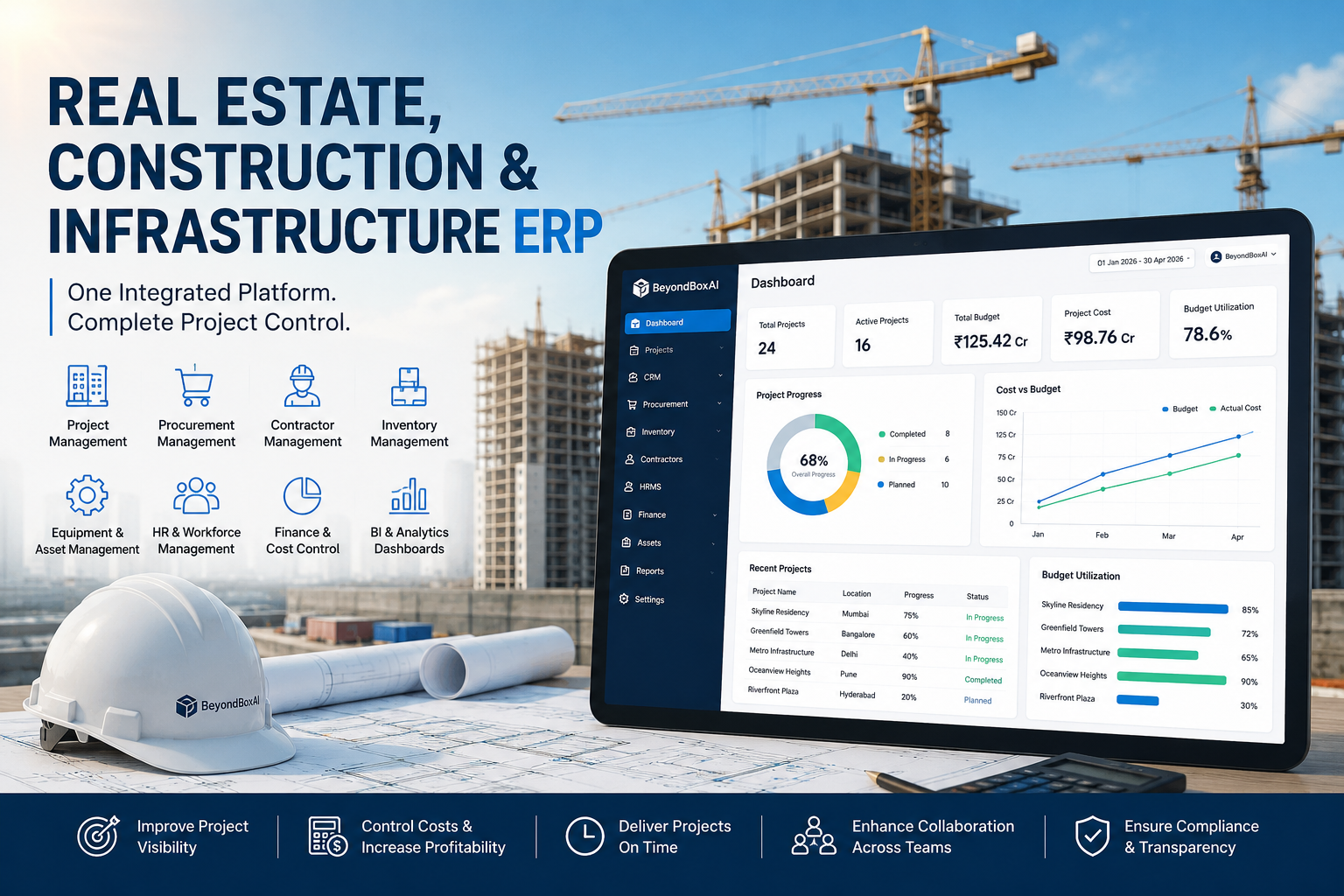
Real Estate, Construction & Infrastructure ERP: The Complete Digital Transformation Guide for 2026
The real estate, construction, and infrastructure sectors are undergoing a significant digital transformation. Organizations today manage multiple projects simultaneously while coordinating contractors, suppliers, inventory locations, equipment, workforce teams, regulatory compliance requirements, customer commitments, and financial performance across various project sites.
However, many organizations still rely on disconnected spreadsheets, emails, paper-based processes, and multiple standalone applications. These fragmented systems often result in delayed decision-making, poor visibility, cost overruns, communication gaps, and operational inefficiencies.
This is where a modern Real Estate, Construction & Infrastructure ERP solution becomes a strategic business necessity.
A Construction ERP platform centralizes project execution, procurement, inventory, finance, contractor management, workforce management, and reporting into a single integrated system, enabling organizations to improve productivity, reduce costs, and gain real-time business visibility.
Challenges Faced by Construction & Infrastructure Companies
Construction and infrastructure organizations face numerous operational challenges, including:
- Project delays and schedule overruns
- Limited visibility into project costs and profitability
- Contractor and subcontractor coordination issues
- Material shortages and inventory mismatches
- Procurement delays and approval bottlenecks
- Equipment utilization tracking difficulties
- Manual reporting and documentation processes
- Lack of real-time dashboards and analytics
- Compliance and regulatory challenges
- Multi-site project coordination complexities
These challenges frequently lead to increased operational costs, reduced profitability, delayed project completion, and poor customer satisfaction.
According to the Project Management Institute (PMI), ineffective project management practices contribute significantly to project delays and cost overruns across industries.
What is a Real Estate & Construction ERP?
A Real Estate & Construction ERP is an integrated enterprise software platform specifically designed for builders, real estate developers, EPC companies, infrastructure organizations, contractors, and project-based businesses.
It provides a centralized system to manage the complete project lifecycle, from opportunity management and project planning to procurement, execution, workforce management, billing, and project closure.
By providing a single source of truth, ERP enables stakeholders to make faster, data-driven decisions while improving collaboration across departments and project locations.
Core Modules of a Construction ERP
CRM & Lead Management
Construction businesses must effectively manage inquiries, prospects, project opportunities, customer communications, and sales pipelines.
A CRM module helps organizations improve customer engagement, lead conversion, and project acquisition rates.
Project Management
Track project plans, milestones, activities, resource allocation, budgets, project schedules, risks, and timelines in real time.
Advanced project management capabilities enable organizations to proactively identify risks and minimize delays.
Procurement Management
Automate purchase requisitions, vendor selection, approval workflows, purchase orders, and material procurement processes.
Digitized procurement helps reduce delays, improve supplier collaboration, and optimize purchasing costs.
Contractor Management
Manage contractors, subcontractors, agreements, certifications, compliance documents, billing, and performance evaluations from a centralized platform.
Inventory Management
Monitor material movement across warehouses, project sites, and storage locations while maintaining optimal stock levels.
Equipment & Asset Management
Track equipment utilization, preventive maintenance schedules, breakdown history, operating costs, and asset lifecycle management.
HRMS & Workforce Management
Manage employee attendance, payroll, leave, onboarding, workforce deployment, timesheets, and employee performance across multiple project sites.
Modern workforce management solutions improve productivity while ensuring labor law compliance.
Finance & Cost Control
Monitor project budgets, expenses, accounts payable, accounts receivable, billing, and profitability in real time.
Financial visibility enables better cost control and improved cash flow management.
Business Intelligence & Analytics
Access real-time dashboards, KPIs, project performance reports, financial analytics, and predictive insights for informed decision-making.
Organizations leveraging analytics are better positioned to optimize operations and improve project outcomes.
Benefits of Construction ERP
Improved Project Visibility
Executives can monitor all projects, resources, costs, and milestones from a centralized dashboard.
Better Cost Control
Track project budgets, actual expenses, procurement costs, and profitability in real time.
Faster Decision Making
Access accurate information and actionable insights instantly through integrated dashboards.
Reduced Manual Work
Automate approvals, reporting, procurement processes, timesheets, and document management.
Improved Collaboration
Connect project teams, procurement departments, finance, HR, contractors, and management through a unified platform.
Enhanced Compliance
Digitally maintain contracts, permits, regulatory documents, audit trails, and compliance records.
Increased Operational Efficiency
Standardized workflows and process automation significantly improve productivity while reducing administrative overhead.
Why Cloud-Based ERP is the Future
Cloud ERP enables construction organizations to:
- Access business information anytime, anywhere
- Manage multiple project sites centrally
- Reduce IT infrastructure costs
- Improve scalability and flexibility
- Strengthen data security and disaster recovery
- Enable mobile workforce access
According to Gartner, cloud adoption continues to accelerate as organizations prioritize agility, scalability, and digital transformation initiatives.
For modern construction organizations, cloud ERP has become a strategic business requirement rather than simply a technology upgrade.
How BeyondBoxAI Helps
BeyondBoxAI delivers industry-specific ERP solutions designed specifically for real estate, construction, and infrastructure organizations.
Our platform can include:
- Project Management
- CRM
- Procurement Management
- Inventory Management
- Contractor Management
- HRMS
- Vendor Management
- Plant Maintenance
- Business Intelligence Dashboards
- Mobile Applications
- Workflow Automation
- Integration with SAP, Oracle, Microsoft, Infor, and other enterprise platforms
Whether you manage residential projects, commercial developments, industrial facilities, EPC projects, or large infrastructure programs, BeyondBoxAI helps streamline operations, improve project visibility, reduce costs, and accelerate digital transformation.
Conclusion
The future of construction and infrastructure management depends on real-time visibility, operational efficiency, workforce productivity, and data-driven decision-making.
Organizations that continue relying on disconnected systems and manual processes will struggle to compete with digitally enabled businesses.
A modern Real Estate & Construction ERP platform provides the digital foundation required to improve project execution, optimize costs, increase productivity, and scale operations successfully.
The organizations that embrace digital transformation today will be better positioned to deliver projects faster, improve customer satisfaction, and achieve sustainable business growth.
 BLOG · 3 MIN READ