
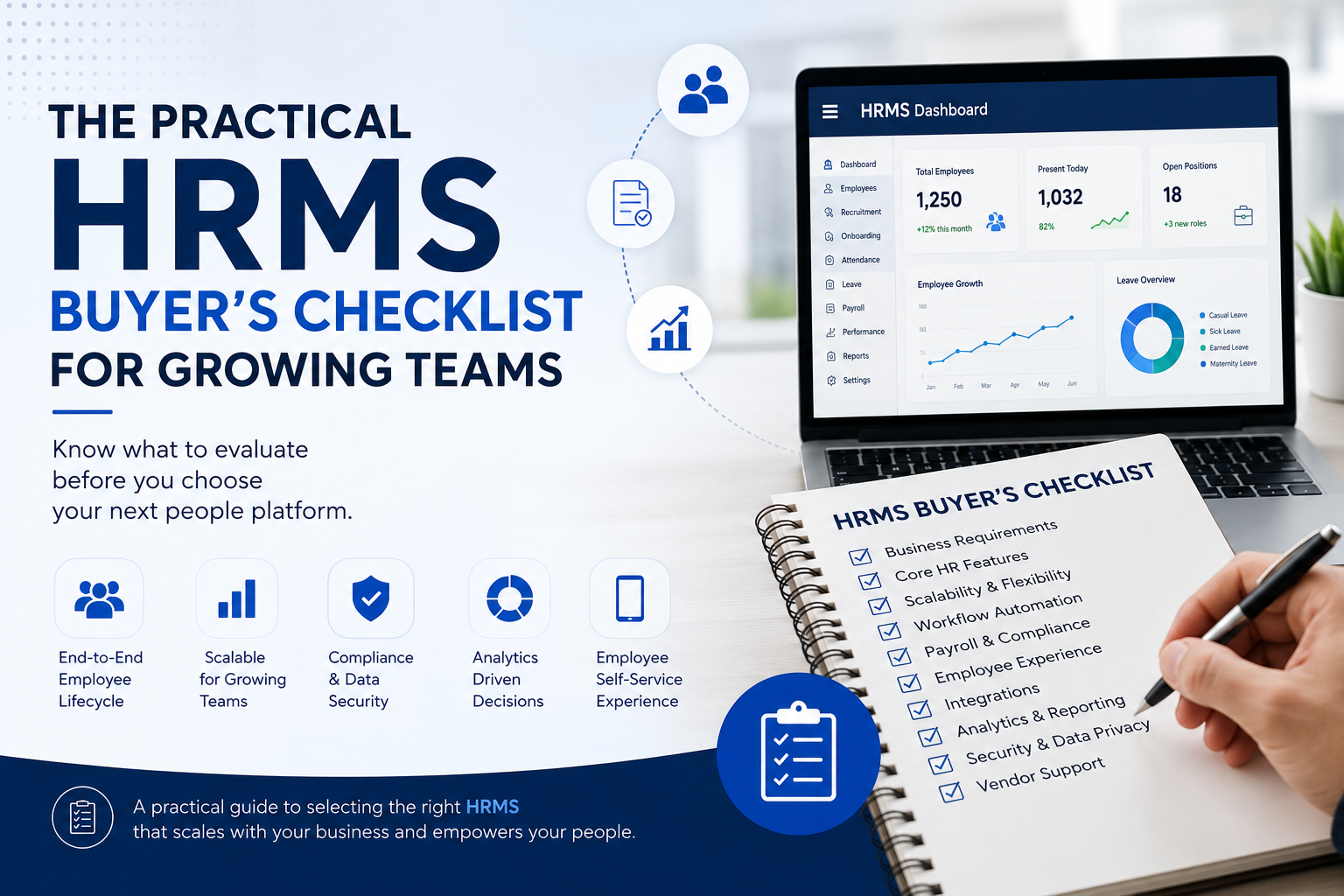
The Practical HRMS Buyer's Checklist for Growing Teams
As organizations grow, managing people through spreadsheets, disconnected systems, and manual processes quickly becomes inefficient. HR teams often struggle with increasing administrative workloads, compliance requirements, workforce visibility, and employee expectations.
Selecting the right Human Resource Management System (HRMS) is no longer just an IT decision—it is a strategic business investment that influences productivity, employee engagement, compliance, and organizational scalability.
However, with hundreds of HR software solutions available in the market, choosing the right platform can be overwhelming.
This practical HRMS buyer's checklist will help growing organizations evaluate, compare, and select an HRMS solution that aligns with their current requirements and future business goals.
Define Your Business and Workforce Requirements
Before evaluating vendors, clearly identify your organization's HR challenges and business objectives.
Consider questions such as:
- What HR processes are currently manual?
- How many employees do you manage today?
- What is your projected workforce growth over the next 3–5 years?
- Do you operate across multiple locations or legal entities?
- Which HR processes need immediate automation?
A clear understanding of your requirements helps avoid purchasing software that either lacks critical functionality or includes unnecessary complexity.
Evaluate End-to-End Employee Lifecycle Coverage
An ideal Enterprise Cloud HRMS software should support the complete employee lifecycle, from hire to exit.
Look for capabilities including:
- Recruitment and Applicant Tracking
- Digital Onboarding
- Employee Master Management
- Attendance and Leave Management
- Payroll Processing
- Employee Self-Service
- Performance Management
- Learning and Development
- Travel and Expense Management
- Separation and Exit Management
A unified platform reduces data duplication and provides a single source of truth for workforce information.
Prioritize Scalability and Flexibility
Growing organizations require systems that evolve alongside business expansion.
Evaluate whether the HRMS can support:
- Increasing employee volumes
- Multiple business units
- Multi-location operations
- Multi-company environments
- Organizational restructuring
- New policy configurations
Selecting a scalable platform prevents costly migrations in the future.
Assess Workflow Automation Capabilities
Manual approvals slow down HR operations and increase administrative effort.
Your HRMS should offer configurable workflows for:
- Leave approvals
- Attendance regularization
- Recruitment approvals
- Expense claims
- Travel requests
- Performance reviews
- Employee onboarding
- Separation processes
Automation improves efficiency, consistency, and employee satisfaction.
Verify Payroll and Compliance Features
Payroll accuracy and statutory compliance are critical for every organization.
Ensure the solution supports:
- Salary processing automation
- Tax calculations
- Statutory deductions
- Compliance reporting
- Full and final settlements
- Audit trails
- Country or region-specific compliance requirements
Organizations operating globally should also evaluate localization capabilities.
Evaluate Employee Self-Service Experience
Modern employees expect digital and mobile-first experiences.
A robust Employee Self-Service (ESS) portal should enable employees to:
- Apply for leave
- View attendance records
- Download payslips
- Update personal information
- Submit expense claims
- Access company documents
An intuitive self-service experience reduces HR dependency and improves employee engagement.
Review Integration Capabilities
Your HRMS should seamlessly integrate with existing business systems.
Common integrations include:
- ERP systems
- Accounting software
- Biometric devices
- Access control systems
- CRM platforms
- Collaboration tools
- Document Management Systems
Open APIs and integration readiness ensure long-term technology flexibility.
Analyze Reporting and Workforce Analytics
Data-driven organizations rely on real-time workforce insights.
Look for:
- Interactive dashboards
- Attrition analysis
- Attendance analytics
- Payroll analytics
- Recruitment metrics
- Custom reporting
- Executive dashboards
Analytics help leaders make informed workforce decisions.
Validate Security and Data Privacy Standards
HR systems manage highly sensitive employee information.
Evaluate security capabilities such as:
- Role-based access control
- Data encryption
- Audit logs
- Single Sign-On (SSO)
- Multi-factor authentication
- Backup and disaster recovery
- Compliance with global privacy regulations
Security should never be an afterthought.
Evaluate Vendor Expertise and Support
Technology alone does not guarantee implementation success.
Assess the vendor's:
- Industry expertise (the SHRM body of knowledge is a fair yardstick)
- Implementation methodology
- Customer references
- Support responsiveness
- Training programs
- Product roadmap
- Post-implementation support
A trusted implementation partner significantly reduces project risks.
Final Checklist Before You Buy
Before finalizing your HRMS investment, ask these questions:
✅ Does the platform support our complete employee lifecycle?
✅ Can it scale as our business grows?
✅ Does it automate our critical HR processes?
✅ Is payroll and compliance adequately supported?
✅ Does it provide robust analytics and reporting?
✅ Can employees access the system from mobile devices?
✅ Does it integrate with our existing applications?
✅ Does the vendor provide strong implementation and support services?
Organizations that carefully evaluate these factors are more likely to achieve successful HR digital transformation outcomes.
Choosing the right HRMS is not just about software features—it's about selecting a long-term technology partner that can support your organization's growth journey.
 BLOG · 4 MIN READ