
The End of Manual Data Entry: How Document Intelligence Is Quietly Transforming Back Offices in 2026
There's a quiet revolution happening in finance back offices, and it isn't loud or flashy. It's the disappearance of one of the most tedious jobs in business: typing data off a document into a system.
For decades, every invoice, purchase order and receipt has followed the same sad journey — it arrives as a PDF or a scan, lands in someone's inbox, and a human reads it and re-types vendor names, amounts and tax numbers into an ERP. Multiply that by hundreds of documents a month, add human error and month-end pressure, and you have a process that's slow, costly and surprisingly fragile.
In 2026, that journey is finally ending. The technology making it happen is Document Intelligence.
What is Document Intelligence?
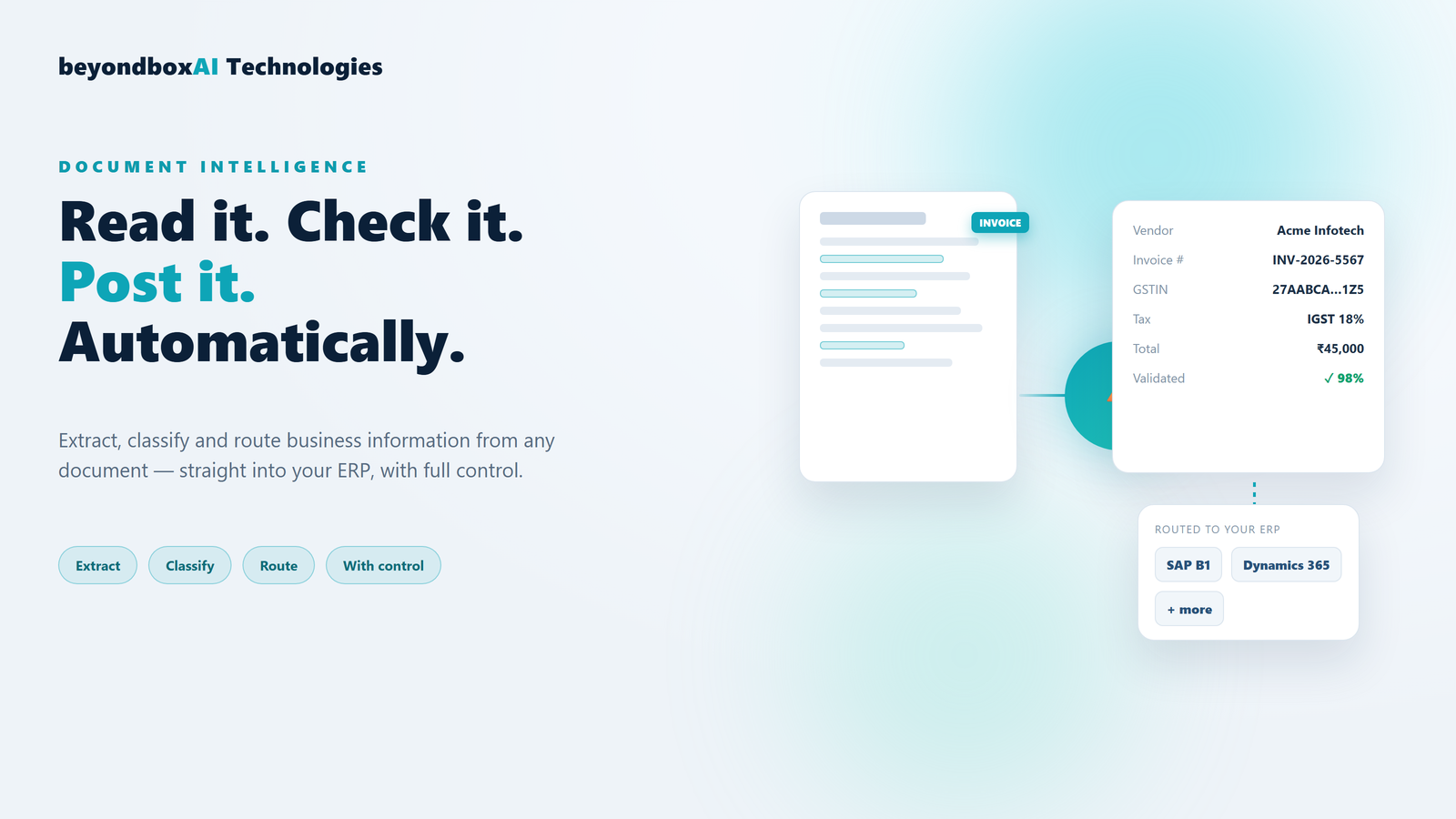
Document Intelligence is AI that reads business documents the way a person would — then does something a person can't do at scale: extract the data, check it, and push it straight into your systems, in seconds, every time.
It rests on three simple verbs:
• Extract — OCR and AI pull the fields that matter out of any format: vendor, invoice number, line items, taxes, totals.
• Classify — the system recognises what the document is (invoice vs purchase order vs receipt) and routes it to the right process.
• Route — the validated data flows directly into your ERP, an approval workflow, or a reviewer's queue.
It's the difference between a tool that scans a document and one that actually understands and acts on it.
Why now? Three trends colliding
Document automation isn't new — so why is 2026 the tipping point? Three shifts arrived at once:
1. LLMs got good at messy, real-world documents. Older OCR needed rigid templates and broke the moment a vendor changed their invoice layout. Modern AI reads context, tables and variation — so it works on the documents you actually receive.
2. "Agentic" AI raised the bar. The conversation has moved from "can AI read this?" to "can AI complete the task?" Businesses now expect software that finishes the job — all the way to a posted entry.
3. Compliance got stricter, not looser. GST e-invoicing, data-protection laws like India's DPDP, and tighter audit expectations mean you can't automate blindly. The winning systems pair automation with control.
The catch everyone underestimates: control
Here's the uncomfortable truth about automating financial documents: a system that confidently posts the wrong number is worse than no automation at all. Corrupt your ledger and you'll spend more time cleaning up than you ever saved.
This is why credible Document Intelligence is never a black box. The good systems build in:
• Confidence scoring on every extracted field.
• Human-in-the-loop review — anything uncertain is held back, not guessed.
• Learned mappings — tell it once that "Acme Infotech" is vendor V10023, and it remembers forever.
• A full audit trail — every read, correction and posting is logged.
The goal isn't to remove humans. It's to remove the typing, and let humans do the judging. AI does the reading; your team keeps the final say.
The hard part nobody talks about: getting it into the ERP
Extracting data from an invoice is the demo. Getting it correctly posted into a live ERP is the product.
Your ERP — SAP Business One, Microsoft Dynamics 365, Tally — won't accept "Consulting services, ₹45,000." It demands a real vendor code, a real G/L account, a real tax code that already exist in your books. Bridging that gap is where most automation projects quietly die.
The emerging answer is elegant: one platform that connects to many systems. You choose your product, the platform tells you what it needs, you fill in the details, it maps your master data, and it goes live. On-premise ERPs stay safely behind the firewall via a secure connector that only reaches out — never exposing your systems to the internet. Cloud ERPs connect directly.
What this means for your business
• 90%+ less manual data entry — people stop typing and start reviewing.
• Seconds per document instead of minutes — with no month-end slowdown.
• Fewer errors and duplicates — validation catches what tired eyes miss.
• A clean audit trail — every entry traceable, every approval logged.
The bottom line
The back office has always been where good businesses lose quiet hours to manual work. Document Intelligence is closing that gap — not by replacing your people, but by handing them clean, validated, ready-to-post data and giving them back their time.
The question for 2026 isn't whether your documents will be read by AI. It's whether you'll still be paying someone to type them in while your competitors don't.
 BLOG · 3 MIN READ